How Green Star Polyps Taught Me to Stop Ignoring the Light Spectrum
How Green Star Polyps Taught Me to Stop Ignoring the Light Spectrum
I’ve kept Green Star Polyps for about eight years now. Across three different tanks, two moves, and one catastrophic powerhead failure that I still don’t like thinking about, they’ve been the one coral that always felt like a sure thing. You know how it goes — GSP spreads like a weed, grows on anything, survives conditions that would make an SPS colony melt into slime. It’s the coral you give to beginners because it’s basically unkillable.
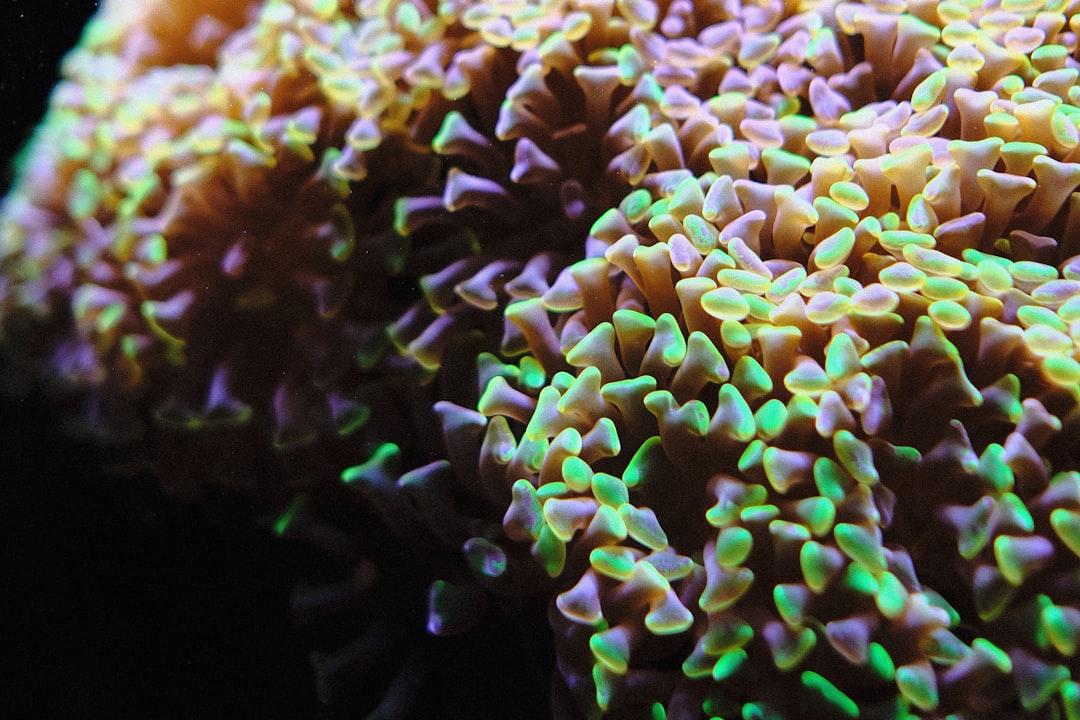
So when mine started looking… off, I almost didn’t notice. The polyps were still extending. They still caught flow and waved around like they were supposed to. But the green had changed. It wasn’t the bright, almost fluorescent lime I remembered from six months earlier. It had gone darker, muddier — more olive than chartreuse. Under the whites, it looked fine. Under blues, the difference was unmistakable.
I called a friend who runs a coral farm about an hour from me. Not a retail shop — a facility behind his house, four 800-gallon vats in a converted garage with a dehumidifier running 24/7. He’s been propagating stuff for twenty years and doesn’t bother with a website. I described what I was seeing.
“Are you still running those T5s?” he asked.
“No, switched to LEDs about eight months ago.”
He laughed. “Yeah, that’ll do it. Come by Saturday. Bring a frag.”
The Old T5 Combo and What Replaced It
My previous tank ran six T5 bulbs — three ATI Blue Plus, two Coral Plus, one Purple Plus. It was a proven combo, the kind of thing everyone ran in 2017 and nobody questions. The GSP under that setup was ridiculous. It grew over the back wall, encrusted a powerhead I’d given up on cleaning, and glowed hard enough to be visible from across the room with only moonlights on.
When I switched to LEDs — a ReefBreeders Photon V2+, for what it’s worth — I was chasing controllability and electricity savings. The tank looked fine. Corals that had been doing well kept doing well. Parameters were stable. I didn’t think about spectrum much after the first few weeks of tweaking channel intensities. I set my blues around 60%, my whites around 30%, and let it run.
It took six months before I noticed the shift in the GSP. That’s the insidious part. Nothing happened overnight. It was the kind of slow drift you can’t catch unless you’re taking photos regularly and comparing them side by side. I wasn’t.
My friend’s setup is all LEDs — a mix of Kessils and some DIY fixtures he built himself with Cree chips. He grows mostly SPS and softies, and everything looks healthy. But when I handed him my GSP frag, he didn’t even put it in his display. He dropped it into a shallow frag tray under a single T5 — an old ATI Blue Plus running on a beat-up Workhorse ballast.
“Leave it there two weeks,” he said. “Come back and tell me what you see.”
I almost argued. The whole point of my visit was to learn something about LEDs, and he was putting my coral under a fluorescent tube from 2012. But I’d driven an hour in Saturday traffic, and the guy has forgotten more about coral coloration than I’ll ever know, so I agreed.
Two weeks later, the frag had regained about 70% of its original brightness. Not fully — it wasn’t back to the old lime — but the shift was obvious even to me. The polyps were lighter, greener, closer to what I remembered.
“Your LEDs are missing something in the blue-green range,” he said. “T5 actinics have a broader peak in that region. Most consumer LEDs don’t. Your coral adapted to what it got, but it couldn’t produce the same fluorescent proteins.”
A Pair of ReefBrite XHO Strips
I spent about three weeks reading forum threads and watching spectrum graphs I barely understood. The short version: many LED fixtures — even good ones — have a gap around 420-450nm where the blue phosphors in T5s produce a fuller curve. The coral’s fluorescent proteins (specifically the GFP-like compounds that give GSP its color) need that specific wavelength range to excite properly. Without it, the polyps still grow. They just don’t glow the same way.
I didn’t want to buy a new fixture. I also didn’t want to go back to T5s — the electricity savings alone had paid for a third of the LED fixture within a year. So I looked into supplementing.
The market for actinic supplement strips is weirdly fragmented. You’ve got the serious ones (ATI’s Sirius line, some GHL stuff) that cost almost as much as a whole new fixture, and you’ve got the cheap Amazon strips that claim to be actinic but are really just 450nm royal blues with marketing. I ended up going with a pair of ReefBrite XHO actinic strips — not cheap, but not ridiculous either, at about $160 each.
Mounting them was straightforward. The Photon V2+ has a pretty standard mounting bracket system, and the ReefBrites come with their own brackets. I ended up running them on a separate timer, coming on an hour before the main fixture and staying on an hour after. Blue channel on the main fixture I dropped to 45%.
The first week, I didn’t see much. GSP doesn’t respond in days. But by the end of the second week, the colony on the back wall started looking… brighter. Not dramatically — nothing you’d notice looking at the tank casually. But I caught myself doing double-takes. The color was shifting back.
By week four, the difference was measurable. I took a photo with the same camera settings I’d used two months prior — same ISO, same white balance preset, same distance. Comparing them side by side, the newer photo showed a significantly lighter, more saturated green. The polyps themselves seemed to extend further, though that could be confirmation bias.
The Numbers Nobody Talks About
I measured PAR at the GSP colony’s location — about 18 inches below the surface, moderate flow area — both before and after. Before adding the actinic strips, with the Photon running at my normal settings, I was getting about 180 PAR at that spot. After adding the strips and dialing back the main fixture’s blue channel, PAR was roughly 210. Not a huge jump, but the spectrum composition had shifted.
The strips themselves pull about 45 watts each. My electricity cost is roughly $0.12/kWh, so running them 11 hours a day adds about $3.50 to my monthly bill. Worth it for the color improvement.
What I didn’t expect: the GSP started growing faster. Not dramatically, but noticeably — the encrusting edge expanded maybe 30% more over two months than it had in the previous two months. I don’t have a good explanation for that. Maybe the additional light in that specific range triggered something. Maybe the coral was just happier. I’m not going to pretend I have a scientific paper’s worth of data.
Other corals in the tank responded variably. My zoanthids — mostly Dragon Eyes and some boring brown ones I inherited — didn’t change much. My single torch coral seemed to appreciate the shift; its tips got marginally brighter. The montipora caps didn’t care at all. The GSP was the only one that made a visible statement.
I did some reading afterward — actual papers, not just forum posts — and learned that coral fluorescent proteins (FPs) aren’t static. They’re produced in response to light conditions, and different FPs have different excitation peaks. The classic green FP from GSP peaks around 488nm, which is right in that gap I mentioned. Under a broad-spectrum T5 actinic, that peak gets hit. Under a consumer LED with a narrow 450nm royal blue, you’re exciting the protein less efficiently.
The coral still produces the protein. It just produces less of it, or the protein’s structure changes slightly because the excitation energy isn’t optimal. The color shift isn’t the coral dying — it’s the coral economizing. It’s spending energy on growth instead of pigment production because the light doesn’t reward the pigment investment.
The Small Annoyances
Not everything went smoothly. The ReefBrites generate a bit more heat than I expected — the strips themselves run warm to the touch, and I had to add a small clip-on fan to my sump to keep the tank temp stable. My apartment runs warm in the summer, and the extra 90 watts of light plus the fan added a noise I didn’t love.
Also, the strips create a shimmer line — a visible band of brighter light across the tank where the LEDs overlap with the main fixture’s spread. It’s not ugly, but it’s there. I notice it when I’m sitting on the couch at a certain angle. Nobody else has commented on it, but I know it’s there.
One night about three weeks in, the timer on the ReefBrites failed — wouldn’t turn off. I came home at 11 p.m. to find the tank lit up like midday. The GSP had fully extended, which was weird because they normally start closing up a couple hours after lights out. I manually killed the power and replaced the timer the next day. No noticeable damage, but it was a reminder that adding complexity to a system always adds failure points.
If I were setting up a new tank today and knew what I know now, I’d probably skip the all-in-one LED fixture entirely and go with a T5/LED hybrid. ATI makes good ones. So does Giesemann. They’re expensive, but they solve the spectrum gap problem from day one. You don’t have to add strips later.
For people already running LEDs who want better GSP color without replacing their fixture: try swapping one or two of your blue channels to something in the 420-440nm range if your fixture allows that. Some fixtures let you swap individual LEDs. Most don’t, in which case a supplement strip is the practical answer.
The cheap Amazon actinic strips I mentioned earlier? I tried one before buying the ReefBrites. It was a $35 strip claiming 420nm output. I measured it with a cheap spectrometer — not lab-grade, but good enough to see the peak — and it was actually peaking at 455nm, which is just royal blue with a different label. Don’t waste your money. You want something that specifically mentions 420-440nm or “true actinic,” not “blue spectrum” or “moonlight.”
I’m already planning my next change — I’ve been eyeing a GHL Mitras LX7 for the main fixture, which has more granular channel control. If I do switch, I’ll keep the ReefBrites as supplements. The GSP has settled into a color now that I’m genuinely happy with — not quite the old T5 lime, but brighter than it’s been in months. That’s good enough for me.
If you’ve done something similar — switched lighting and watched your softies change color — I’d love to hear your experience. Drop a comment below.
📷 Photos: Jonas Gerlach (Unsplash), Ed Rush (Unsplash)