How a Single Coral Frag from a Friend Became My Tank’s Most Aggressive Stunner (And Why I Dug It Out)
How a Single Coral Frag from a Friend Became My Tank’s Most Aggressive Stunner (And Why I Dug It Out)
It started with a plastic takeout container and a Tuesday night that I still don’t fully trust.
My friend Marco showed up at my door around 8:30, which for him is late — he usually texts by 6 if he’s coming over. He was holding one of those black rectangular containers you get pad thai in, the kind with the clear lid that’s always a little warped from the steam. Inside was a single frag of Montipora capricornis, maybe two inches across, mounted on what looked like a repurposed plastic bottle cap.
“It was leaning against the glass in my sump for three months,” he said. “I forgot I even had it. Thought you might want it.”
I did want it. I wanted it the way I want any free coral, which is to say I wanted it badly enough to ignore every instinct that said ask where it came from first. Marco’s tank is beautiful — a 180-gallon mixed reef he’s had running since 2016 — but he’s also the kind of guy who fragged a colony of Pocillopora once and then forgot about the parent colony for six weeks. His sump is a graveyard of good intentions.
“What’s the lineage on this?” I asked, already peeling back the lid.
“Honestly? No idea. I got it from a guy in Gardena two years ago. It’s been through three tanks.”
Three tanks. Two years. A bottle cap for a plug. I should have put it in my frag rack and watched it for a week. Instead, I glued it to a piece of dry rock near the middle of my display — about seven inches from a branching Acropora I’d been growing for eight months, and maybe ten from a small Favia that had never given me trouble.
That was February. By May, I was scraping Montipora slime off my sand bed with a razor blade.
The Growth Wasn’t Fast — It Was Wrong
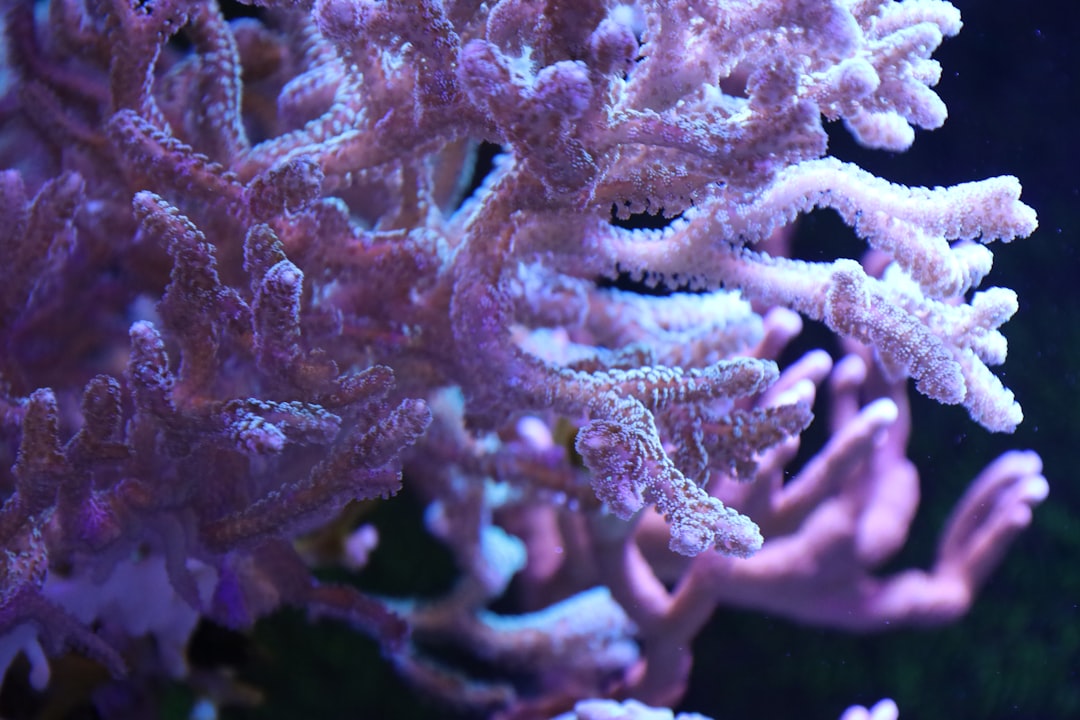
Here’s the thing about Montipora capricornis: it’s supposed to be a plating coral. You see it in the ocean as these elegant, wavy shelves, like someone dropped a stack of purple dinner plates and they happened to land perfectly. In a healthy tank, it grows outward in concentric circles, creating this layered, tiered effect that a lot of people specifically set out to achieve.
Mine didn’t do that.
It grew like it was trying to escape. The base encrusted the rock it was on within three weeks — that part was normal. But then instead of plating upward, it sent out these long, thin overhangs, like eaves on a house, stretching toward the Acropora like it had a grudge. Every night, I’d come home from work and find the sweepers a little longer. I measured once: a quarter-inch of new growth in a single day.
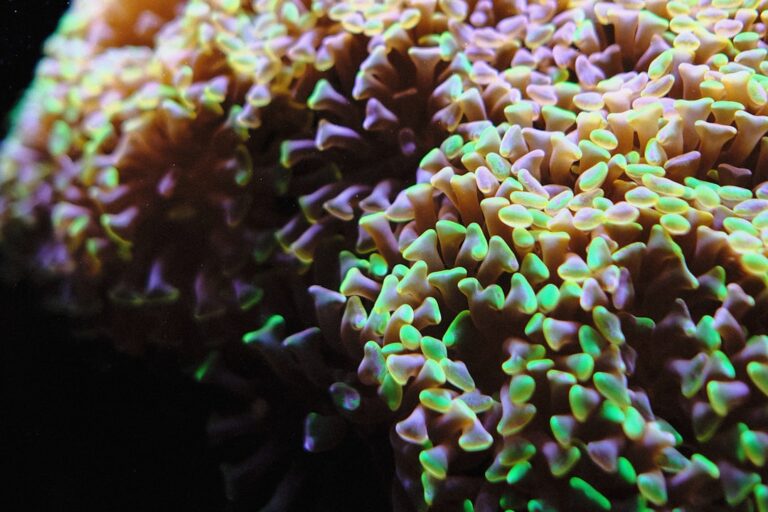
I told myself it was fine. Healthy coral grows fast, right? And it was healthy — the color was this deep, iridescent purple with bright green polyps that looked almost fluorescent under my Radions. People who came over would stop in front of the tank and say “what’s that?” in a tone I read as admiration but should have read as concern.
Marco came by in late April, looked at it for about three seconds, and said “oh, that’s the one from my sump, huh.” Not a question. He knew.
“It’s getting big,” I said, trying to sound proud.
“It’s getting everywhere,” he said. “You should probably trim it back.”
I should have trimmed it back. I should have fragged the overhangs, pulled the encrusting edge off the rock, maybe even moved the whole thing to a remote frag tank. I did none of those things because — and this is the honest part — I liked watching it grow. There’s a dopamine hit to seeing measurable progress in a reef tank, and that coral was a dopamine factory. Every day brought something new: a new edge, a new shelf, a new polyp extending into the current like it was tasting the water.
I was collecting data, not managing a system.
The First Sign I Ignored
In early June, I noticed the Acropora had stopped extending its polyps. It was still alive — the tissue was intact, the color was fine — but it had gone from full, fluffy daytime extension to a tight, defensive posture where only the tips showed.
I checked parameters: alk 8.3, calcium 420, magnesium 1350, nitrate 5, phosphate 0.03. Everything fine. I did a 15-gallon water change, bumped up the flow a little, moved the Acropora an inch higher in the rockwork. Nothing changed.
What I didn’t check was the undersides of the Montipora plates. If I had, I would have seen the sweepers.
Montipora species are aggressive in a way that’s easy to miss, especially if you’re used to keeping Acropora or Seriatopora, which make their intentions known through visible stinging when they’re within an inch of something. Montipora doesn’t sting in the traditional sense — it sends out these long, thin mesenterial filaments at night, basically its digestive system reaching out to dissolve whatever it touches. They’re nearly invisible under white light, especially if you’re not looking for them. But at night, with a flashlight, they look like spiderwebs made of pale yellow thread.
I wish someone had told me that. Not “corals compete for space” — I knew that. I wish someone had said “that specific coral, the one you’re watching grow every day, will reach across your scape like a ghost and eat everything it touches, and you won’t see it happening until things start dying.”
The Favia was the first casualty. I noticed it on a Saturday morning — a white patch about the size of a pencil eraser on the side facing the Montipora. By Monday, the patch had doubled. By Wednesday, half the Favia was gone, and the Montipora had grown a new shelf directly over where the Favia used to be.
I pulled the Favia out and put it in my sump. It never recovered.
The Week I Lost Control
After the Favia died, I decided I needed to act. But “act” for me meant “trim the overhangs with bone cutters,” which is the reefing equivalent of putting a Band-Aid on a compound fracture.
I cut away about six square inches of plating material, pulled the pieces out, and dropped them in a bucket of tank water. I felt proud. I’d made a decision. I’d done something.
What I didn’t do was address the encrusting base. The part that was glued to the rock. The part that had spread about four inches in every direction and was now fused to the rockwork in a way I couldn’t separate without removing the entire boulder.
Within two weeks, the cut edges had healed and the coral was growing faster than before. It’s a known thing with Montipora — fragging it triggers a growth response, like the coral thinks it’s being eaten and needs to reproduce before it dies. I’d fragged plenty of corals before. I knew this. I just didn’t apply the knowledge to my own tank the way I would have if I’d been advising someone else.
The Acropora finally died on a Thursday. I came home from work and it was completely white — not the pale, slow death of a nutrient issue, but the sharp, overnight bleaching of tissue that’s been chemically dissolved. The Montipora had grown a full inch past where the Acropora used to be, and the sweepers had reached it cleanly.
I sat on my couch and stared at the tank for maybe twenty minutes. The Montipora looked beautiful. It was the only coral in that entire quadrant of the tank that was thriving. It was purple and green and perfectly healthy, and it had killed two of my favorite corals without breaking a sweat.
That’s when I realized: the problem wasn’t the coral. The coral was doing exactly what corals do. The problem was me.
Why I Dug It Out
I spent a week trying to figure out a way to keep the Montipora and rearrange everything around it. I moved the surviving corals to the other side of the tank. I repositioned my powerheads to create a flow boundary. I even looked into buying a frag tank specifically to isolate aggressive corals, which is the kind of purchase you make when you’re trying to solve a behavioral problem with equipment.
Then I talked to a guy named Dave at my LFS — the one who works behind the counter on Saturdays, about sixty, with a salt-and-pepper beard and the kind of patience you develop from answering the same questions for thirty years. I told him the whole story: the container, the sump, the bottle cap, the melting Favia, the bleached Acropora, the growth response after fragging.
He listened. Then he said: “So you have a coral that grows fast, looks great, and kills everything around it. And you’re trying to keep it?”
“It’s beautiful,” I said.
“It’s a weed,” he said. “Weeds can be beautiful. That doesn’t mean you keep them.”
I went home and pulled the rock out of the tank. It was a Saturday afternoon, around 3 p.m., and the light was starting to shift from high noon to afternoon — the tank looked warm and golden, the kind of light that makes every coral look its best. The Montipora was glowing. I almost put the rock back.
Instead, I took it to the kitchen sink, got out a flathead screwdriver and a hammer, and chipped the coral off the rock in about twelve pieces. The sound was horrible — that wet, cracking noise of calcium carbonate breaking. The pieces went into a plastic bag. The bag went into the freezer. That felt dramatic, but I didn’t trust myself not to give the frags away to someone else who’d make the same mistake.
The rock itself I scrubbed with a stiff brush and let dry in the sun for two days. I’m not taking chances.
Blind Spots by the Dinner Plate
I’ve been keeping marine tanks for about four years now. I’m not a beginner, but I’m not an expert either — I’m in that dangerous middle zone where I know enough to be dangerous but not enough to recognize my own blind spots. The Montipora capricornis thing was a blind spot the size of a dinner plate.
A few things I’d tell my past self, if I could:
First: source matters more than I wanted it to. Marco got that frag from a guy in Gardena who’d been keeping it in a system with high nutrients and unpredictable lighting. That coral had evolved — in the short-term, selective sense — to grow aggressively because it had to compete for resources in a messy environment. It wasn’t a “peaceful” plating coral. It was a survivor. I put it in my clean, stable system and gave it good light, good flow, and low competition, and it did exactly what it was programmed to do: dominate.
Second: base encrusting is the real threat, not the plates. I was watching the visible growth — the shelves, the overhangs, the stuff I could photograph. The real spread was happening along the rock, millimeters at a time, invisible unless I pulled the whole rock out. By the time I saw the sweepers, the coral already owned the territory.
Third: don’t keep corals you’re afraid to remove. I knew I should have pulled that Montipora in early May. I didn’t because I liked it. That’s the whole reason — not because it was hard to remove, not because I needed more time to research, but because I was emotionally attached to a coral that was actively killing my other corals. That’s not husbandry. That’s hoarding.
The Space It Left
The tank looks different now. There’s a gap where the Montipora used to be — about eight inches of bare rock that I haven’t decided what to do with yet. I put a small Leptastrea in one corner, and it’s growing slowly, peacefully, in a way that almost feels boring after the Montipora. I have to remind myself that boring is good. Boring means stable. Boring means I’m not going to wake up one morning and find another coral dissolved.
Marco came by last week and noticed the empty space. He didn’t say anything for a minute, just looked at the tank. Then he said “you pulled it.”
“I pulled it.”
“Good call.”
I’m not sure it was a good call. I’m not sure it was a bad call either. It was a necessary call, which is different. Sometimes the necessary call doesn’t feel good — it just feels like the only door left open.
I still think about that coral sometimes. The color was really something. I probably would have gotten a lot of compliments if I’d kept it.
📷 Photos: Anastasia (Unsplash), David Clode (Unsplash)