Black Slate in a Tropical Tank—What Day 400 Looks Like
Black Slate in a Tropical Tank—What Day 400 Looks Like
The hardscape looked good on installation day. Dark, angular, dramatic—the kind of structure that photographs well before the water even goes in. Six months later, the driftwood had softened into something unrecognizable. The bark peeled away in sheets. What hadn’t rotted outright had developed a biofilm that refused to scrub off, and the whole thing smelled, subtly but unmistakably, like a pond in August.
This is the reality of a wood-based scape in a tropical climate. Room-temperature water that stays above 26°C year-round accelerates decomposition, and the standard advice—soak it, boil it, rinse it—delays but doesn’t prevent the eventual breakdown. For anyone keeping a tank longer than a year, the question becomes less about what looks good on day one and more about what holds up on day 400.
Black slate is one answer. It doesn’t decompose. It doesn’t leach tannins. It doesn’t soften or crumble. But it also doesn’t behave like wood, and treating it as a simple substitute is how people end up with scapes that look flat, unnatural, or—worse—structurally unstable.
The Vinegar Test at the Shop Counter
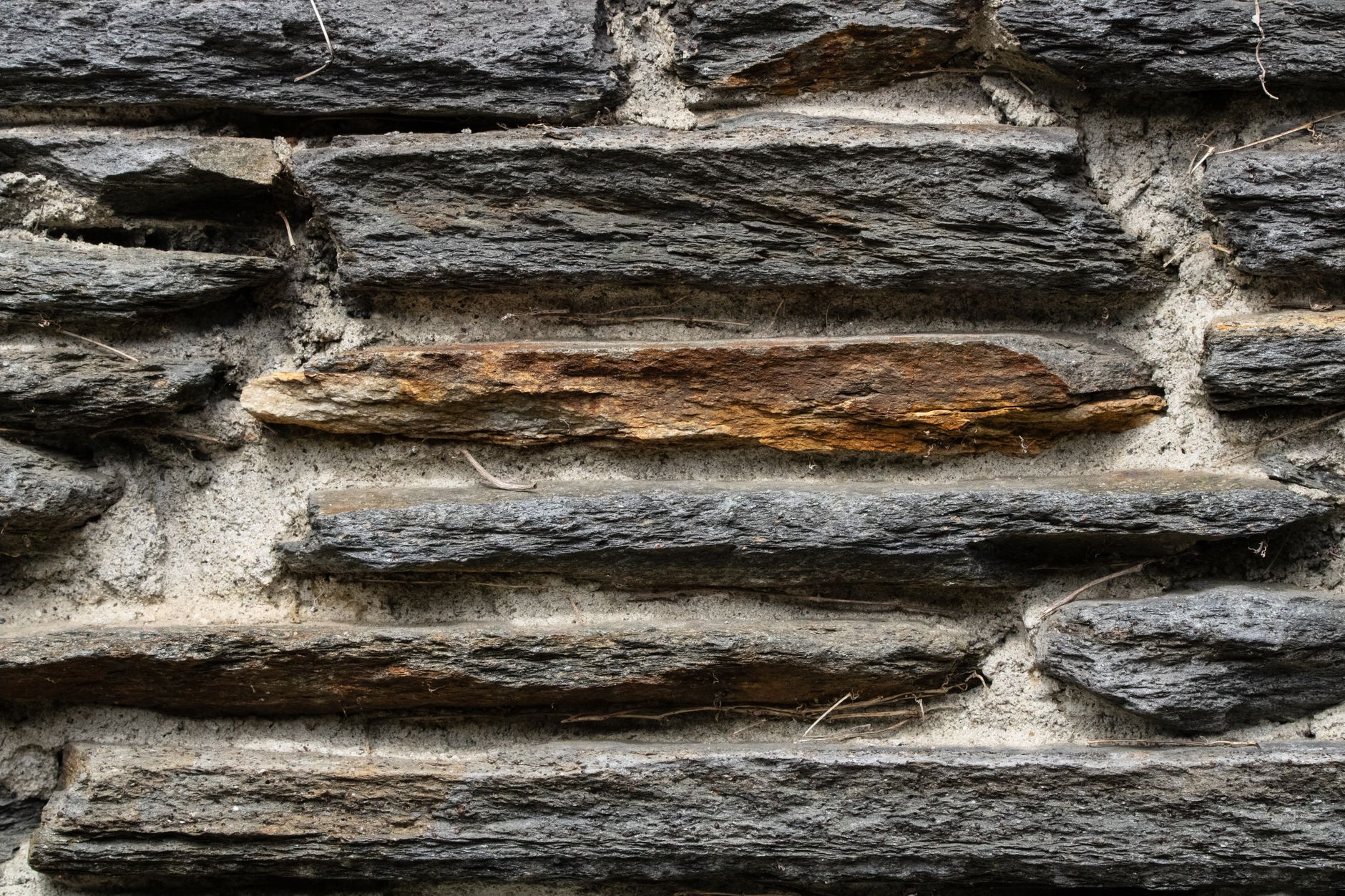
Not every dark stone works in an aquarium. The defining property of slate, geologically speaking, is that it splits along flat planes, which is what gives it those layered, angular shapes that look deliberate even when they aren’t. But slate comes in different grades, and some of it contains mineral veins that dissolve slowly in water.
The safe option is black slate sourced specifically for aquascaping, sold by the kilogram at shops that specialize in planted tanks. It’s been tested for reactivity and doesn’t contain calcite or pyrite, both of which can harden water or produce harmful compounds. Landscape-supply slate, by contrast, is often mixed with other stone types and is a gamble.
The price difference matters. Aquascaping-sold slate runs roughly 8 to 15 ringgit per kilogram in most Malaysian and Singaporean shops, while landscape slate can cost half that. On a 60-centimeter tank, the difference works out to maybe 30 ringgit. It’s the kind of saving that feels smart in the moment and foolish six months later when the water parameters shift.
A better approach: buy from a shop that lets you inspect the rock in person. Drop a few drops of white vinegar on a clean surface. If it fizzes, the stone contains calcium carbonate and will harden the water over time. No fizz means it’s safe.
One Strike, Not a Hundred
Slate breaks along its natural grain. That’s the feature that makes it useful—you can split a thick slab into thinner plates with a hammer and chisel—but it’s also the trap. A single misplaced strike can send fractures running through the whole piece, rendering it useless.
The mistake most beginners make is trying to carve slate like wood, removing material incrementally until the shape emerges. Slate doesn’t work that way. The correct method is to score the intended break line with a masonry blade or a sharp chisel, then strike sharply once. The stone will split along the score, and the break will be clean.
Gloves are non-negotiable. Slate edges are sharp, and a slip while holding a chisel can produce a cut that requires stitches. Safety glasses, too—stone dust in the eye is a particular kind of pain that doesn’t resolve quickly.
For precision work, a wet tile saw with a diamond blade is the tool of choice. It produces edges that are straight and clean enough to stack without wobbling. Rental costs around 80 ringgit for a day, which is worth it if anyone is building a scape larger than 45 centimeters.
When Gravity Is Enough, and When It Isn’t
The advantage of slate over most other hardscape rocks is that its flat surfaces can be stacked like bricks. A well-chosen piece of slate will sit on another without shifting, provided the surfaces are clean and the edges are reasonably flat.
This matters because glue in an aquarium introduces variables—curing time, potential toxicity if the wrong type is used, and the fact that a poorly glued joint will fail eventually anyway. Stacked slate, relying on gravity and surface friction, is repairable. A single stone can be removed and replaced without dismantling the entire structure.
But gravity has limits. For scapes taller than 30 centimeters or for pieces that overhang significantly, mechanical stability requires adhesive. The industry standard is two-part epoxy putty designed for aquarium use, sold by brands like Seachem and JBL. It sets underwater, dries to a neutral grey, and bonds to slate well enough that breaking the joint later requires chiseling the rock itself.
The cost for a small tube is about 25 ringgit. One tube is enough for a 60-centimeter scape with three or four joints. It’s cheap insurance against a collapse that would crush plants and stress fish.
The Corner, Not the Center
A common error with slate is building upward without building backward. Because the stone breaks into flat planes, there’s a natural tendency to create wall-like structures that are tall but shallow—a single layer of stacked slabs that looks two-dimensional from the front.
The fix is simple: tier the scape so that the highest point is not at the center but shifted to one side or the back corner. The golden ratio, roughly 1:1.618, applies here. A scape where the highest point sits at about one-third of the tank width, with descending plateaus stepping toward the opposite side, creates a sense of depth that a centered structure never achieves.
This is where slate’s texture becomes an asset. Unlike wood, which tends to be uniform in color and grain, slate has subtle variations in shade—ranging from deep charcoal to blue-grey—that catch light differently depending on orientation. A piece placed with its grain running horizontally reflects light differently than one placed vertically. Using both orientations in the same scape adds visual interest without any extra effort or cost.
One Drop, Fifteen Seconds
Wood anchors plants naturally. Moss ties to bark. Anubias wedges into crotches. Slate, being smooth and hard, offers no such grip.
The workaround is to create pockets. When stacking slate, leave deliberate gaps between layers—small cavities large enough to hold a clump of substrate or a glued plant mount. These gaps serve the same function as the crevices in wood, but they must be designed in from the start. Retrofitting a planted pocket into an already-assembled scape is difficult and risks destabilizing the stack.
For epiphytic plants like Java fern and Bucephalandra, gel-based cyanoacrylate glue is the most reliable method. A single drop on the root mass, pressed against the slate for fifteen seconds, produces a bond that lasts years. The glue whitens on contact with water, but the discoloration fades within days and is invisible once the plant grows in.
The mistake is overgluing. More glue does not mean a stronger bond. A smear across the entire root system seals out water and prevents the plant from absorbing nutrients. One drop per attachment point is enough.
120 to 260 Ringgit, Once
For a standard 60x30x36 centimeter tank, a full slate scape runs roughly:
– 8 to 12 kilograms of aquarium-grade black slate: 80 to 140 ringgit
– Epoxy putty for critical joints: 25 ringgit
– Gel glue for plants: 15 ringgit
– Wet tile saw rental (optional): 80 ringgit per day
Total: 120 to 260 ringgit, depending on whether the saw is rented and how much stone is used.
By comparison, a single piece of Malaysian driftwood suitable for a tank of that size costs 60 to 100 ringgit and lasts maybe 18 months before significant decomposition sets in. Over three years, the wood approach requires replacement at least once, pushing the total cost into the same range as slate. The difference is that the slate scape is done once and doesn’t require redoing.
For anyone considering it, the advice is simple: buy the right grade, cut carefully, stack low and wide, and let the plants do the work of softening the edges. The rest is just patience.

📷 Photos: Tim Dusenberry (Pexels), Engin Akyurt (Pexels)