
Why That Glass Box Took 47 Days to Grow Anything
The ammonia test stayed a flat, perfect yellow for three weeks. Every morning the same ritual — rinse the tube three times with tank water, fill to the line, add the reagent, shake, wait five minutes — and every morning the same result. Not a hint of green. Not even a whisper of nitrite, either. The tank looked like someone had bottled distilled water and called it a day.
This was a 10-gallon tank. Glass, rimless, sitting on a white cabinet in a third-floor apartment in a city where the tap water comes out at a pH of 7.8 and the humidity makes everything feel damp. The assumption, based on every cycle guide written in the last decade, was that a fishless cycle with bottled ammonia and a heater set to 78°F would finish in roughly four weeks. Plenty of people online claimed three. Some said two, if you seeded the filter with media from an established tank.
The 47-day mark was not the result of major errors. It was the result of a series of small, reasonable decisions that each added a week.
The first surprise was the source water itself. The city treats its supply with chloramine, not chlorine, which breaks down differently and doesn’t off-gas in 24 hours the way plain chlorine does. The conditioner used for the first few water changes — a standard supermarket brand — claimed to neutralize chloramine, but the ammonia test after a full dose still read somewhere between zero and 0.25 ppm. Not a crisis. But also not zero. Over time, those fractional carryovers accumulated, and the bacteria colony’s growth curve stretched out accordingly.
This is the kind of detail that cycling articles tend to mention in a single sentence toward the bottom of a paragraph, after the main instructions. “Some conditioners may leave residual ammonia.” It reads like a footnote. In practice, it means the first two weeks of the cycle were spent processing not just the deliberately dosed ammonia but a slow background leak from the water itself.
The second factor was temperature stability. The heater — a 50-watt adjustable with a reputation for reliability — held the tank at 78°F during the day. At night, the apartment’s central air dropped the ambient room temperature to 64°F, and the heater couldn’t quite keep up. The tank would settle around 74°F by morning, then climb back up over the course of the afternoon. Not a dramatic swing. But nitrifying bacteria metabolize slower at lower temperatures, and the daily fluctuation meant they never operated at peak efficiency for a full 24-hour stretch.
One afternoon, halfway through the third week, a thermometer check showed 76°F at 2 PM and 77°F at 6 PM. The heater was running constantly. It was doing its job, but the room was fighting it. A bigger heater might have smoothed the curve. A different placement of the tank — away from the air vent — would have helped. Both were obvious in retrospect.
The third issue was invisible but measurable: pH drift. The tank started at 7.8, which is fine for cycling. But as ammonia was dosed and converted to nitrite, and nitrite converted to nitrate, the pH began to drop. By week four, it had fallen to 7.2. By week five, 6.8. At that level, the bacteria’s activity slows noticeably. Some strains of Nitrosomonas and Nitrobacter handle acidic conditions poorly. The cycle didn’t stall entirely, but it crept.
The solution was a partial water change with a small amount of baking soda to buffer the pH back up. This is a common fix. What isn’t commonly mentioned is that the baking soda itself needs to be dissolved in a cup of tank water first, added slowly, and tested after an hour, because overshooting the pH can shock the bacteria as badly as letting it drop. A single overcorrection — aiming for 7.4 and landing at 7.8 instead — would have reset the clock by several days.
By day 30, the tank looked like it should be done. Ammonia was clearing in 24 hours. Nitrite was spiking but dropping within 48. The standard advice says a tank is cycled when it can process 2 ppm of ammonia to zero ammonia and zero nitrite within 24 hours. This tank could do it in 30 hours. Close enough, most people would say. And that’s where the cycle’s final delay came from: the gap between good enough and actually finished.
Adding fish to a tank that’s 90% cycled is a gamble. The remaining 10% of the bacteria colony will catch up over time, but the fish produce waste continuously, and the margin for error is thin. One overfeed, one dead plant leaf, one day of missed testing, and ammonia spikes. The sensible choice — the one the guides recommend but the impatient often skip — is to wait until the tank confirms stability over several consecutive days of the same test result. That took another 17 days.
During that stretch, the tank’s surface developed a faint biofilm. A thin, oily-looking sheen that caught the light each morning. It wasn’t harmful. It was a sign of bacterial activity on the water’s surface, feeding on organic compounds. Some aquarists skim it off with a paper towel. Others ignore it. In this case, it was left alone as a visual marker — something to watch as the final days passed. When the sheen finally broke into small patches and then disappeared entirely, it happened to coincide with the day the ammonia and nitrite both read zero for the fourth straight morning.
The whole process was not a failure of equipment or a mistake in dosing. It was a series of constraints — water chemistry, room temperature, pH sensitivity — that each added a few days, and the cumulative effect was a timeline that stretched close to 50% beyond the standard estimate. The guides were not wrong. They were optimistic.
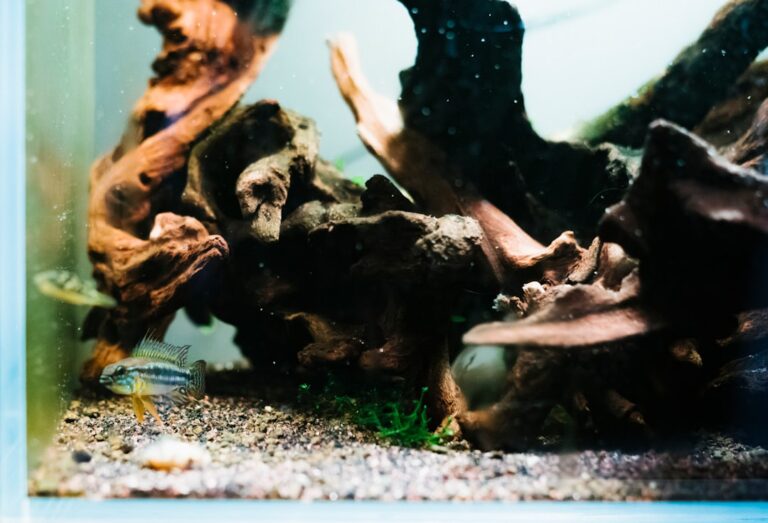
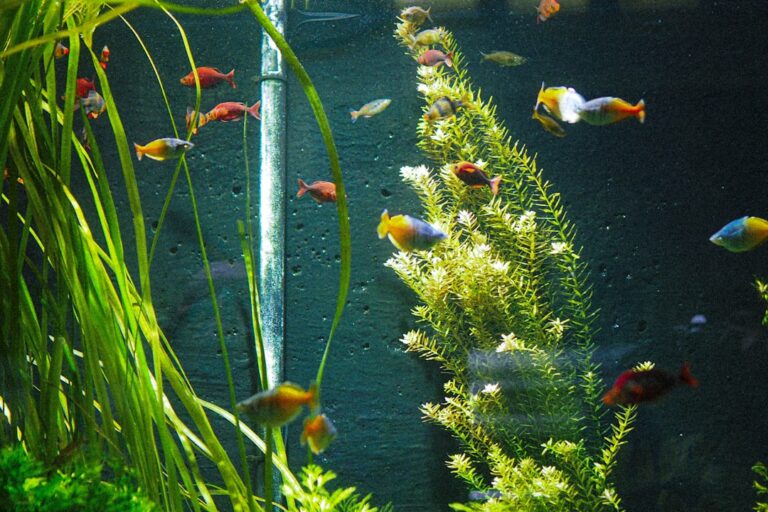
On day 47, a single nerite snail went in, then a small school of ember tetras a week later. The snail climbed the glass and left a trail of eggs that never hatched. The tetras stayed near the middle of the water column, fins held upright, foraging through a tank that had taken almost seven weeks to become something other than sterile water in a glass box. The biofilm never came back.

📷 Photos: Osheen Turnbull (Unsplash), mohammad ebrahimi (Unsplash)